
Dopamine Collection: Crystal Coin Beads, Craft & Everyday Style

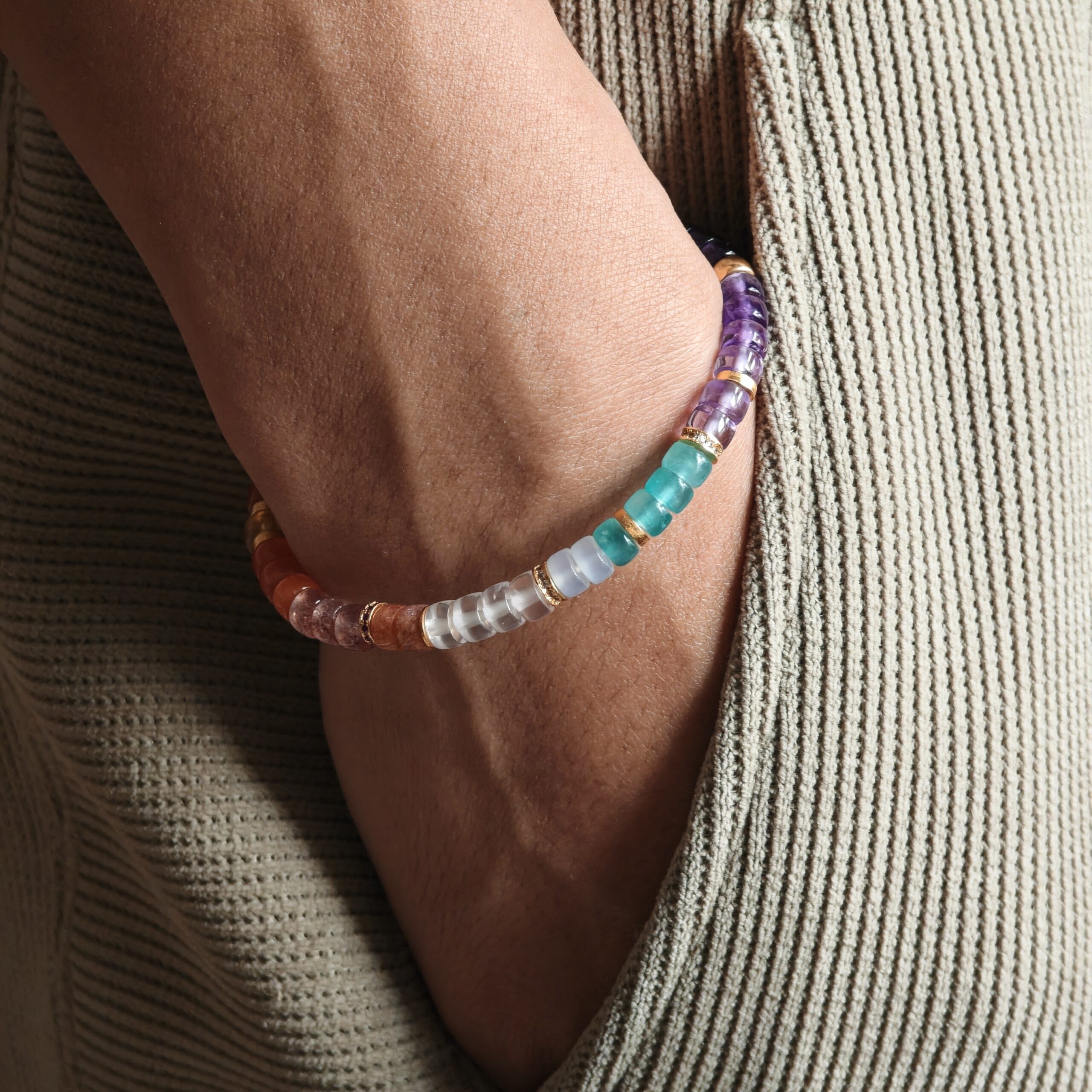
Crystal Coin Beads, Craft & Everyday Style
Most crystal bracelets are round. Ours is not — and that is the entire point.
The coin bead bracelets in our Dopamine Collection are made of flat, disc-shaped crystal beads: thin slices of stone, polished on both faces, drilled through the center, and strung edge to edge. From a distance they read as a smooth band of color. Up close, you can see each individual slice — the grain, the inclusions, the slight difference in thickness from piece to piece.
Our Dopamine Collection explores natural stone color through flat, coin-shaped beads. This article looks at their materials, craftsmanship, and everyday styling.
What follows is the honest case for the shape itself — why it exists, why it costs more, and what it actually feels like to wear.
What “Pill Shape” Actually Means
In the trade, this cut is called a tablet bead or disc bead. Some sellers call it a capsule bead. The construction is straightforward:
- Flat faces — both sides are ground and polished flat, so the bead looks like a thin coin rather than a sphere.
- Center-drilled — the hole runs through the flat face, so the beads stack face against face along the string.
- Edge-polished — the outer rim is smoothed so the bracelet rolls comfortably against skin instead of catching on it.
The result is a bracelet that lies flat on the wrist rather than sitting up on top of it. That single physical difference changes everything about how it looks and how it wears.
Why Pill Beads Cost Two to Five Times More Than Round Beads
This is the part most buyers never hear, so let me say it plainly: the material is not the expensive part. The labor is.
A round bead is made by tumbling. Rough stone goes into a rotating drum with abrasive grit, and hundreds of beads round themselves off together over days. The machine does the work. Volume is high, unit cost is low, and the process is forgiving — if a bead comes out slightly off-spherical, nobody notices.

A pill bead cannot be tumbled into shape. It has to be:
- Sliced — the rough stone is cut into thin slabs, and every cut wastes material as dust. A block that would yield one round bead may yield one slice of comparable diameter.
- Ground flat on both faces — one at a time, on a flat lap. Spheres only need to be roughly round; a disc needs two genuinely parallel, genuinely flat surfaces. If the faces are not parallel, the bead sits crooked on the string.
- Drilled — through the thin dimension. Drilling a flat slice is far more prone to chipping and blowout than drilling a solid sphere, because there is so little material around the hole.
- Edge-polished individually — the rim must be eased by hand or by a small-wheel machine. There is no batch process for this.
Add it up: higher material loss, more than double the handling steps, a higher scrap rate at drilling, and fewer workshops willing to do the work at all. That is why a pill bead strand costs two to five times what the same stone costs in round beads — and why you rarely see them.
We are not charging more because the stone is rarer. We are charging more because somebody had to hold each slice.

How It Looks and Wears
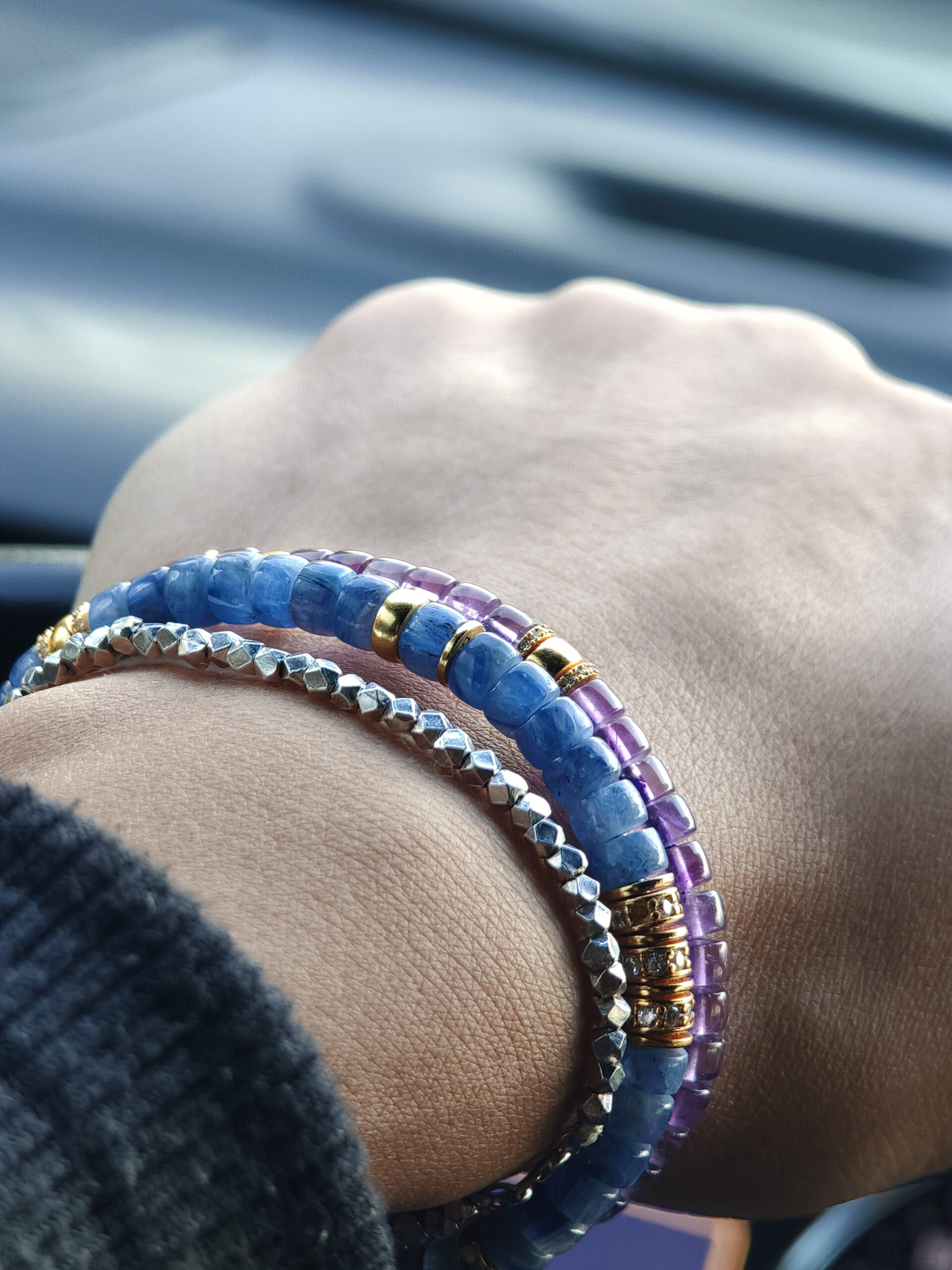
It reads as a single continuous line. Because the beads are parallel discs, the light hits one flat face after another at nearly the same angle. Instead of the scattered sparkle of a sphere, you get a smooth run of color — almost like a ribbon.
It suits stacking. Two or three pill bracelets worn together form flat, even layers that sit flush against each other. Round beads of different sizes tend to jostle; discs align. This is why the series works best in sets rather than singly.
It sits close to the wrist. The profile is low. Under a shirt cuff, it disappears. Against bare skin in summer, it looks deliberate rather than decorative.
The edge matters more than the face. A poorly finished disc edge is unpleasantly sharp. Ours are eased and polished until the rim rolls rather than catches — worth checking on arrival.
What We Do Not Claim
This is the part where most crystal brands lose me, so I will be direct about where we stand.
We do not tell you this bracelet will bring you luck, wealth, prosperity, or good fortune. We do not invoke feng shui placement rules. We do not say it cures, treats, relieves, or prevents anything — not anxiety, not illness, not pain. Those are medical claims, they are not true of a piece of stone, and in the United States they are not legal to make.
What we will say is narrower and, we think, more useful:
- A tactile anchor. The flat faces and polished edges are pleasant to turn between your fingers. Many people find a physical object to touch helps them pause — the same reason worry beads and rosaries exist across nearly every culture.
- A small ritual. Putting something on in the morning, deliberately, is a way of marking the start of a day. The bracelet is a reminder you chose, not a command.
- Color as mood. Bright citrine, soft amethyst, milky quartz — the visual effect of a saturated band of color on the wrist is real and immediate. Liking what you see when you look down is a legitimate reason to wear something.
If that is enough for you, this bracelet will serve you well. If you are looking for a treatment, this is not it, and we would rather you know that before you buy.
Material Honesty
The Dopamine Collection is cut from natural crystal. That word “natural” comes with obligations, and here is how we meet them.
We name what it is. Citrine is citrine. Amethyst is amethyst. We do not use a trade name in place of a mineral name, and we do not describe a stone as something it is not.
We disclose treatment. If a stone is heat-treated — as most commercial citrine is, since true unheated citrine is rare and expensive — the listing says so. Heated amethyst sold as citrine is industry standard, but it must be stated, and we state it.
We do not call inclusions defects. A natural crystal may carry fine internal lines, color zoning, or mineral inclusions. In a flat slice these are more visible than in a sphere, because you are looking straight through a thin cross-section of the stone. They are the record of how the crystal grew. Every slice is different, and no two bracelets will match exactly. If you want perfectly uniform, glass-clear, identical beads, natural stone is the wrong material and we would rather tell you now.
We do not grade-inflate. You will not see “AAA” on our listings. There is no universal grading standard behind that label, so it means whatever the seller wants it to mean. We describe what we can actually verify: bead diameter, thickness, stone type, treatment status, and country of origin.

Sizing and Care
Sizing. The pill profile sits differently from a round bead bracelet, so measure your wrist rather than guessing from a previous bracelet. Wrap a strip of paper snugly around your wrist bone, mark it, and measure flat. Add roughly half an inch for a close fit, or three quarters for a relaxed one. If you are between sizes and plan to stack, size up.
Care. Wipe with a soft dry cloth. Avoid perfume, chlorine, and long soaking — the polish on the flat faces is what gives the bracelet its look, and abrasives dull it. Store flat, not hanging, so the string is not under constant tension. Elastic will eventually relax; we string with slightly higher tension to allow for it.
If it does not fit, write to us. We are a small operation and we answer our own messages.
Why This Shape
There is a practical answer and a less practical one.
The practical answer: round beads are everywhere, made by the million, and there is no reason for a small brand to compete there. Pill beads are difficult, slow, and rare. That is a defensible place to stand.
The less practical answer: a flat disc forces you to notice the material. A sphere hides its interior behind curvature and glare. A slice puts the inside of the stone on display, thin enough to see through. You are not looking at a polished ball that happens to be citrine. You are looking at a cross-section of something that grew underground for a very long time, cut thin so you can see it.
We think that is worth five times the labor.
Dopamine Collection — a different shape, honestly made.
Woodseed Stone. Wood. Seed. Stone. Real things, honestly carried.